



05 Jun 2026
In the UK, vaping has continued to rise over the last few years. An ONS survey around adult smoking habits confirms that around 5.4 million adults aged 16 years and over (10.0%) used an e-cigarette daily or occasionally in Great Britain in 2024, overtaking around 4.9 million current smokers (9.1%) for the first time in 2024. This figure has grown steadily year-on-year and highlights a major change in the population’s nicotine consumption habits.
This article includes the latest UK vaping statistics, looking at regional trends, adult and youth use, addiction risks and health impacts – supported by expert insights from Lester Morse, Director of Rehabs UK, who has an extensive background within the addiction field. More addiction statistics can be found on Rehabs UK’s dedicated pages for cocaine and alcohol addiction.
Table of Contents
- Key vaping statistics
- Vaping in the UK (Adults)
- Youth vaping statistics
- Youth vaping statistics
- Vapes and health
- Addiction treatment
- Concerned about vaping addiction?
- Bibliography
Key vaping statistics
Key findings:
- E-cigarette use remained highest among people aged 16 to 24 years in Great Britain, with 13.0% using e-cigarettes either daily or occasionally. This is a decrease from 2023 (15.8%).
- Daily e-cigarette use was highest with people ages 25 to 34 years and 35 to 29 years in Great Britain (9.3% and 9.5%) it has also increased among both age groups from 2023.
- Daily vaping has increased, so now 7.6% of people vape every day, up from 4.5% in 2020.
- Of ex-smokers who vape, 91% vape daily, and just under half (49%) of dual users do.
- 58% of ex-smokers who vape have done so for over 3 years.
- Vaping among smokers increased rapidly between 2013 and 2014, remaining at a similar level until 2021, averaging roughly 17% to 20% over seven years. Specifically, it stood at 17% in 2021. after which it rapidly increased, coinciding with the arrival on the market of modern disposable vapes. This increase was largely fuelled by smokers who had previously tried vapes starting to use them again.
Vaping in the UK (adults)
- From 2012 to 2025, vaping prevalence rose from 1.7% to 10.4%. Growth slowed after 2024, suggesting a plateau.
- According to a report from July 2025, there are an estimated 5.5 million vapers in Great Britain.
Adult vape use by gender
The percentage of men who reported using e-cigarettes daily or occasionally (e-cigarette users) in Great Britain decreased in 2024 compared with 2023 (10.1% and 11.0%, respectively), while among women, e-cigarette use increased from 8.5% in 2023 to 10.0%.
Adult vape use by age
- Vaping has plateaued across all age groups under 55. (13%).
- Most common in 25–34-year-olds (16%)
Reasons for vape use
- Ex-smokers: 26% say to help them quit, 20% say they use it as relapse prevention
- Smokers: 16% say to reduce smoking, 13% say for enjoyment
- Never-smokers: 35% say due to stress, 31% for enjoyment
Youth vaping statistics
There have been ongoing concerns regarding the increase in under-18s vaping and vaping in schools. Although it is illegal to sell a nicotine vape to anyone under the age of 18 in the UK, there has been evidence to suggest many are still finding a way to consume them.
The NHS has conducted a study looking at smoking, drinking, and drug use among young people. The latest survey (published in 2024) of secondary school pupils in England in years 7 to 11 (mostly aged 11 to 15) found that:
- In 2023, 11% of pupils had ever smoked (12% in 2021), 3% were current smokers, and 1% were regular smokers (both unchanged from 2021)
- Current e-cigarette use (vaping) remained at 9%, the same as in 2021
- 1 in 4 pupils (25%) in the 2023 survey reported having tried vaping
- Of pupils who had ever tried vaping, 89% never regularly smoked tobacco cigarettes
- A further 6% reported starting vaping before smoking tobacco cigarettes; only 5% of pupils reported smoking tobacco cigarettes before using vapes.
ASH Youth Survey also conducted a study on young people and vaping, examining vaping among 11-17-year-olds in Great Britain.
Findings:
- Children who have ever vaped among 11-17 year olds plateaued at 20% (an estimated 1.1 million children) between 2023 and 2025.
- Current vaping also plateaued at 7% (400k children), following a doubling from 3% in 2021 to 7% in 2022.
- Regular vaping (more than once a week) plateaued at 4% in 2025 (230k children), after rising from 1% in 2021 to 4% in 2023.
- 3% currently vape daily (160k children)
- Experimentation (tried once or twice) is the most common form at 11% (an estimated 640k children)
Vaping use by age
- 11–15-year-olds: 16% ever vaped; 5% currently vape.
- 16–17-year-olds: 30% ever vaped; 12% currently vape.
- 18-year-olds: 28% ever vaped; 15% currently vape.
Vaping by smoking status
49% of 11-17 year olds who currently smoke also vape, compared with 27% of those who’ve stopped smoking.
Among the 77% of 11-17 year olds who report never having smoked, 10% have tried vaping and 2% currently vape.
‘Ever smoked’ has increased in 2025 compared to 2023, as has the intention to try smoking among those who have never smoked. Current smoking has not significantly increased.
Regional trends
ONS data shows people in deprived areas are four times more likely to vape. The same pattern exists with smoking—highlighting the role of social and environmental factors.
- There are lower rates in affluent southern regions
- Northern England has higher rates
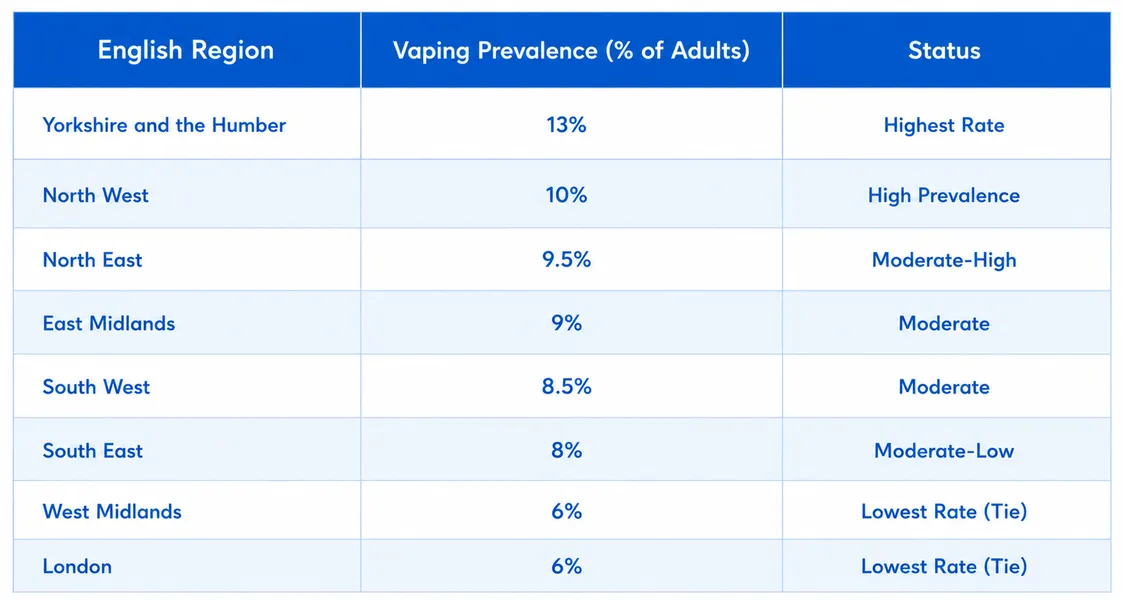
Vaping prevalence rates across English regions, including Yorkshire and the Humber, North West, North East, East Midlands, South West, South East, West Midlands and London, with percentage of adult vapers and regional status rankings
Vapes and health
The health implications surrounding vaping are gradually making themselves known; however, there is still a lack of evidence to see long-term effects.
One thing that is known is that nicotine remains highly addictive, whatever format it is consumed in. It may also be important to mention that vaping appears to be a more socially acceptable addiction compared to others, such as alcohol.
The common immediate negative effects can sometimes include:
- Dizziness
- Dry mouth
- Headaches
- Nicotine dependence
Warning signs of potential vape addiction include:
- Mood swings
- A strong irritability when unable to vape
- Physical symptoms such as nosebleeds, dizziness or nausea
- Anxiety
Addiction Treatment
Although there may be a lack of inpatient nicotine addiction treatment, Only about 44.8% of public health/smoking cessation providers in England offer dedicated vaping cessation support. There are always options available to help combat the addiction.
At Rehabs UK, we offer multiple therapy options, such as CBT or holistic approaches, as well as detox and support groups.
Scott Ardley, Senior Treatment Advisor, states:
“I recently supported someone in long-term recovery who said quitting vaping was far harder than quitting cigarettes. Even with patches and support, the withdrawal and emotional swings were more intense.”
This suggests that vaping addiction should be taken seriously and that it has and continues to contribute to the new wave of nicotine dependency.
Concerned about vaping addiction?
If you or someone you know is dealing with vaping addiction, it is key to find professional help. Do not hesitate to contact our fully-trained treatment advisors for a confidential chat.
Rehabs UK offers specialist addiction treatment services tailored to each individual's needs. Make the first step towards recovery today!