
30 Mar 2026
With comment from: Lester Morse, Director of Rehabs UK (35+ years in addiction treatment)
Defining success in drug and alcohol rehabilitation is more complex than a simple yes or no. Does rehab work? The answer depends on what we mean by success.
For some, success means complete abstinence. For others, it means harm reduction, improved mental health, stable employment, or rebuilding relationships. Government data may define success as “treatment completion,” while clinicians may look at reduced hospital admissions or criminal activity. Families often measure success in hope restored.
This article examines what percentage of people recover, what the data says about rehab success rates, and why long-term recovery depends on far more than simply completing a programme. As Lester Morse, Director of Rehabs UK, explains:
“Success is different for everyone. For me, I consider someone successful when they begin to show the capacity to live to their full potential. You see them move from self-centred survival to communal responsibility. That’s when real recovery begins.”
Table of Contents
- Drug rehab success rates by the numbers
- What factors influence rehab success?
- Reframing relapse
- Comparing different treatment models such as 12 Step and Non 12 Step
- How to choose a programme with high success rates
- Bibliography
- Related articles
Drug rehab success rates by the numbers
When asking “what is the success rate of drug rehab?” or “do rehab centres work?”, it’s important to understand how statistics are calculated.
UK Treatment Completion Data
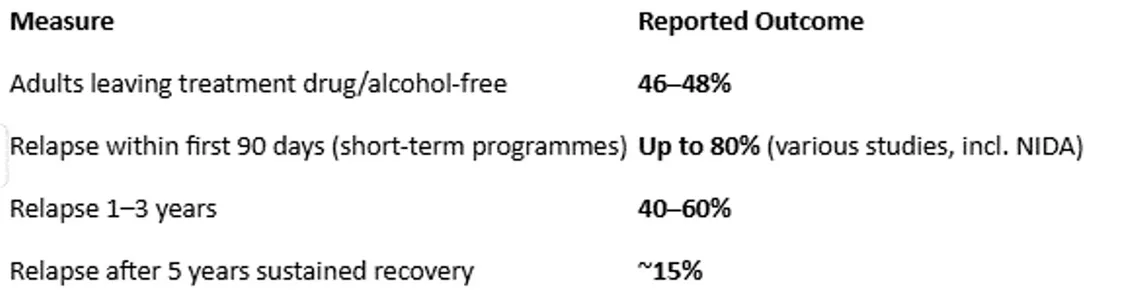
According to the UK’s National Drug Treatment Monitoring System (NDTMS) 2024–2025:
UK Treatment Completion Data
At first glance, a 48% completion rate sounds promising. But Lester Morse offers caution:
“These figures often reflect how the system grades itself. If you define success as completing a programme, you may claim 48%. If you define success as sustained long-term recovery, the number changes dramatically.”
What percentage of people survive drug addiction?
- The majority of individuals do survive addiction with treatment.
- Mortality risk decreases significantly after sustained remission.
- After 5 years of continuous recovery, relapse rates drop substantially and long-term survival improves markedly.
Inpatient and outpatient success rates
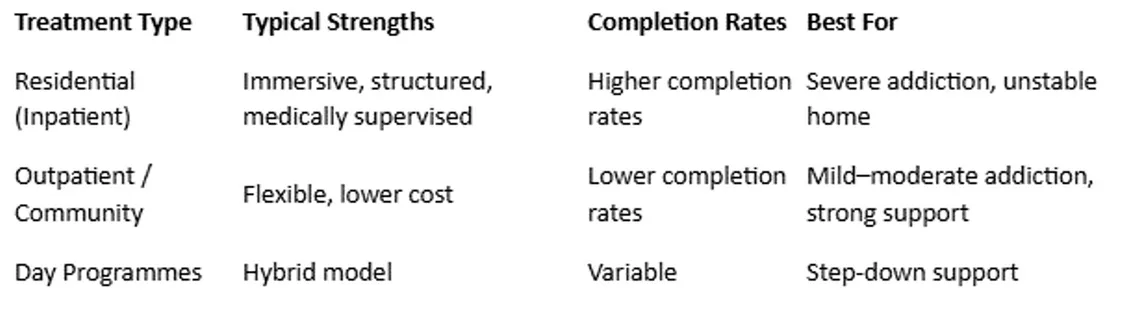
When comparing inpatient rehab vs outpatient rehab, the data suggests:
Inpatient and outpatient success rates
Residential environments often show higher completion rates due to reduced triggers and 24/7 support. However, this is not a competition. Some individuals need intensive short-term care. Others need longer-term structured support. Addiction severity, brain health, trauma history, and social stability all influence outcomes.
As Lester notes:
“The environment is king. A strong recovery environment, plus the right information, plus time equals better outcomes.
“If you take well-trained staff out of a rehab environment, you end up with a crack house. The environment shapes the brain.”
For more on this comparison, see: Inpatient rehab vs outpatient rehab: what to expect.
Success rates by substance
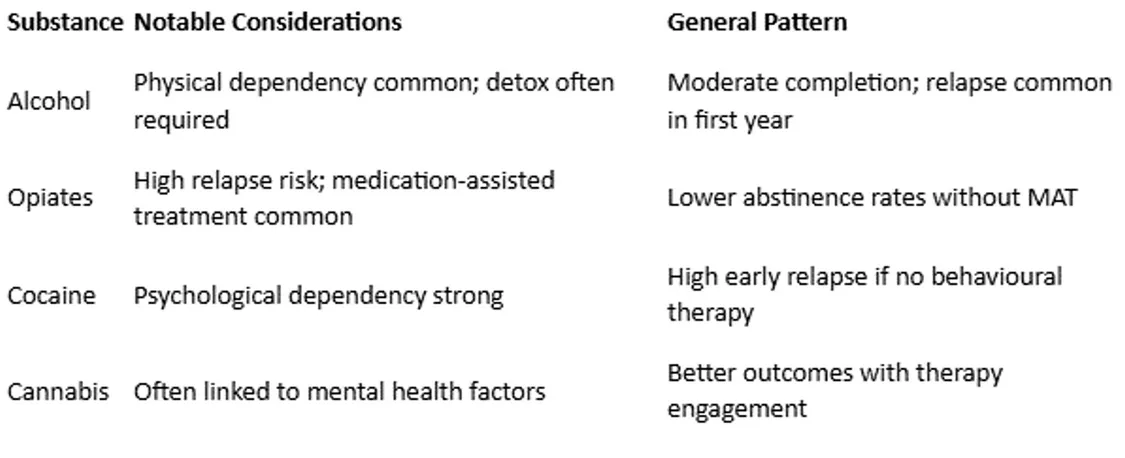
Success rates vary depending on the substance:
Success rates by substance
What is the success rate of rehab for alcoholics?
Government data suggests around 50% complete treatment alcohol-free, but relapse risk remains high within the first year.
Notably:
- 65–80% may relapse within 1–3 years (varies widely by severity and engagement).
- After 5 years of sustained sobriety, relapse drops to roughly 15%.
For comparison, the percentage of alcoholics who recover on their own is significantly lower than those receiving structured treatment and ongoing support including relapse prevention.
What factors influence rehab success?
Statistics fluctuate because recovery depends on multiple variables:
- Readiness and motivation
- Length of treatment
- Type of therapy
- Aftercare availability
- Quality of therapeutic environment
- Social stability
The importance of being "ready"
Does rehab work if someone is forced into treatment?
Often, no.
“A sick brain can’t cure a sick brain,” says Lester. “If you want to change your life, you have to change your mind. In rehab, you can literally see the moment someone’s mind switches on.”
Psychological readiness significantly improves outcomes. Compulsory or externally pressured treatment may achieve short-term detox, but long-term transformation requires internal motivation.
Interventions can sometimes create that turning point (see: What is an addiction intervention and how does it work?).
Duration of treatment
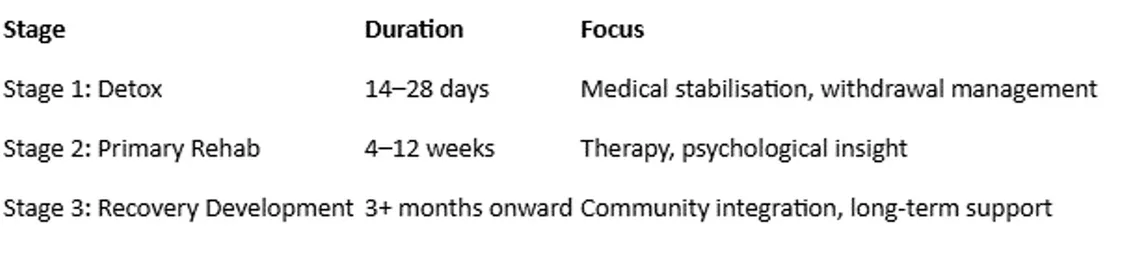
Lester breaks abstinence treatment into three stages:
Duration of treatment
Detox programs are crucial for alcohol and certain drugs, but:
“The problem cannot be completely solved in 28 days. It’s a false period. Symptoms reduce quickly, but the deeper issue remains.”
Research consistently shows longer treatment durations correlate with better outcomes, particularly when followed by structured aftercare that includes individual and group therapy as well as peer support.
Reframing relapse
The odds of relapse are comparable to those of other chronic illnesses, such as diabetes or hypertension. Estimates range from 40–60%, particularly within the first year.
But relapse does not equal failure.
“Relapse can be a turning point,” Lester explains. “It highlights triggers. It shows where development is still needed. You have to fight for the way out.”
Long-term recovery often includes setbacks. After 5 years of sustained remission, relapse likelihood drops significantly — and if relapse occurs, it is often shorter and less severe.
For support during setbacks, see: Struggling in Recovery? Useful Hints and Tips of What You Can Do.
Comparing different treatment models
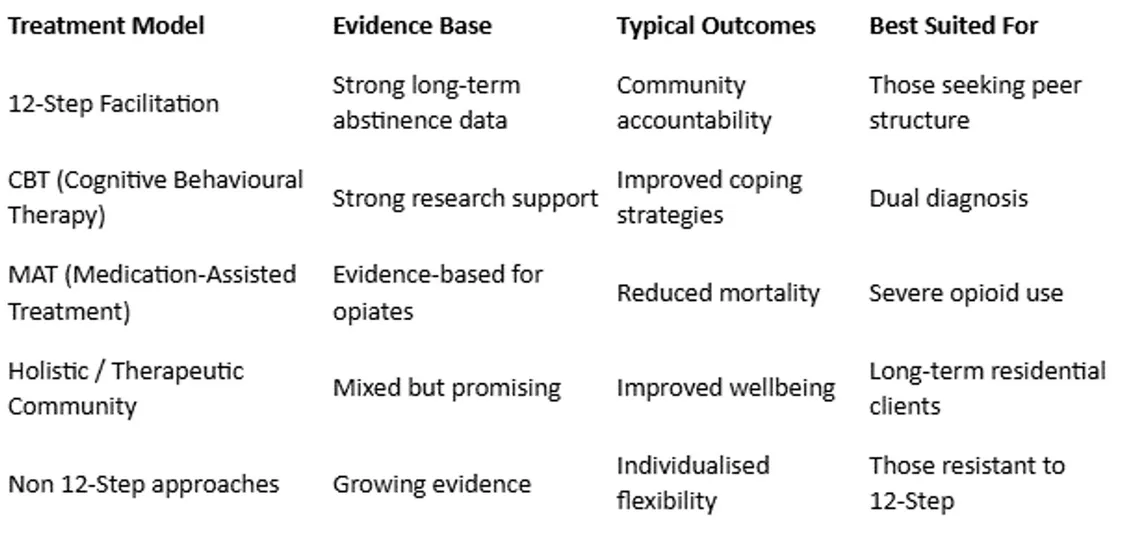
Comparing different treatment models
Which rehab has the highest success rate?
There is no universal “best.” Outcomes improve when:
- The programme matches the individual.
- The environment is strong.
- Aftercare is structured.
- Engagement is genuine.
As Lester says:
“You can’t transmit what you don’t have. If the therapist has recovery and wellbeing, that carries weight beyond any single technique.”
How to choose a program with high success rates
When evaluating a provider, look for:
- CQC registration and strong inspection ratings
- Integrated medical detox (if required)
- Clear aftercare programme (minimum 12 months recommended)
- Evidence-based therapies
- Strong peer support integration
- Transparent outcome data
Statistics offer guidance — but personal circumstances matter more. At Rehabs UK, we believe “Strong recovery environment + the right information + time = better outcomes.”
If you’re exploring Alcohol Rehabilitation or Drug Rehab in the UK, speak to an advisor who understands both the data and the lived experience behind it.
If you or a loved one need support, reach out to Rehabs UK for confidential, expert advice and find the right treatment pathway for you.
Bibliography
National Drug Treatment Monitoring System (NDTMS) 2024–2025
National Institute on Drug Abuse (NIDA) – Relapse Rates and Treatment Effectiveness
Public Health England – Adult Substance Misuse Treatment Statistics
World Health Organization – Management of Substance Use Disorders