

16 Jul 2026
While conversations surrounding substance misuse can often be obscured by stigma, the reality of drug dependence across the UK is a public health crisis that’s causing 5,000 UK deaths annually and costing an estimated £20 billion per year.
To look past the headlines, this page synthesises the most up-to-date UK substance misuse statistics from reputable authorities, including the Office for National Statistics (ONS) and the NHS.
This comprehensive breakdown explores the prevalence of drug use in the UK, its devastating health impacts, regional disparities, and the current landscape of treatment options available to bridge the gap between raw data and real-world support.
Drug use prevalence in the UK
Source: Adult substance misuse treatment statistics 2024 to 2025: report - Published December 2025.
- In 2024-25, 46% of adults in treatment had a problem with opiates, crack, or both.
- 20% used opiates alone.
- 4% used crack without opiates.
- In the year ending March 2025, people with household incomes of less than £10,400 per year (10.9%) and £20,800 (8.1%) were more likely to use cannabis than higher earners.
- Meanwhile, those earning over £52,000 were more likely to have used a Class A drug (4.4%)
50% of people starting treatment for opiates in this period had injected at some point. 33% said they had previously injected, while 16% said they were currently.
Usage, by drug type
Source: Adult substance misuse treatment statistics 2024 to 2025: report - Published December 2025. Drug misuse in England and Wales: year ending March 2025 - Published December 2025.
ONS data for the year ending March 2025 identified the following trends:
- Cannabis remains consistently the most widely used drug, consumed by 6.5% of adults and 12.5% of young adults in the research period.
- Use of cocaine remained consistent at around 2.1% for people aged 16 to 59-year-olds, and 2.3% for 16 to 24-year-olds. This is almost half what it was for 16 to 24-year-olds in 2015 (4.7%).
- Ecstasy use in the year ending March 2025 remained consistent with 2024, with around 1.2% of adults up to 59-years-old taking the drug in the previous 12 months.
- While ketamine use remained steady at 2% of young adults, the wider 16 to 59-year-old demographic’s use has increased from 0.5% in 2015 to 0.8% (2025).
- Hallucinogen use among young adults nearly halved to 1.5%, as of March 2025, due to a drop in magic mushroom consumption (from 2.3% to 0.9%) in 16 to 24-year-olds.
- Nitrous oxide use saw a significant decrease in 2025, falling from 0.9% to 0.5% among adults and from 3.3% to 1.3% among young adults.
Obtaining drugs
The Crime Survey for England and Wales (CSEW) found that of adults (16-59-years-old) who had taken drugs in the last 12 months:
- Got drugs from a friend or neighbour (43.5%)
- Had a known dealer (13.5%)
- Said it would be ‘very’ or ‘fairly’ easy to obtain drugs within 24 hours (36.4%)
Source: Drug misuse in England and Wales: year ending March 2025. ONS - Published December 2025.
Frequency of drug use, by age
- Around two-thirds of drug users in both age groups use substances infrequently, with the vast majority indulging just 1 to 2 times per year.
- Young adult users (16 to 24) are more prone to regular weekly or periodic patterns, suggesting drug use tied to social events and weekends.
- Active drug users aged 16 to 59 are more likely to develop chronic habits, showing a higher rate of daily or near-daily use than young adults.
This list shows the percentage breakdown of how frequently adults who admitted drug use in England and Wales in were using in the year ending March 2025 (Young adults 16-24/Adults 16-59):
- Every day: 5.68% / 7.81%
- 3-5 days per week: 5.07% / 6.05%
- 1-2 times per week: 10.62% / 8.03%
- 2-3 times per month: 6.29% / 6.35%
- Once a month: 7.78% / 6.04%
- Once every 2-3 months: 23.88% / 16.4%
- 1-2 times per year: 40.68% / 49.58%
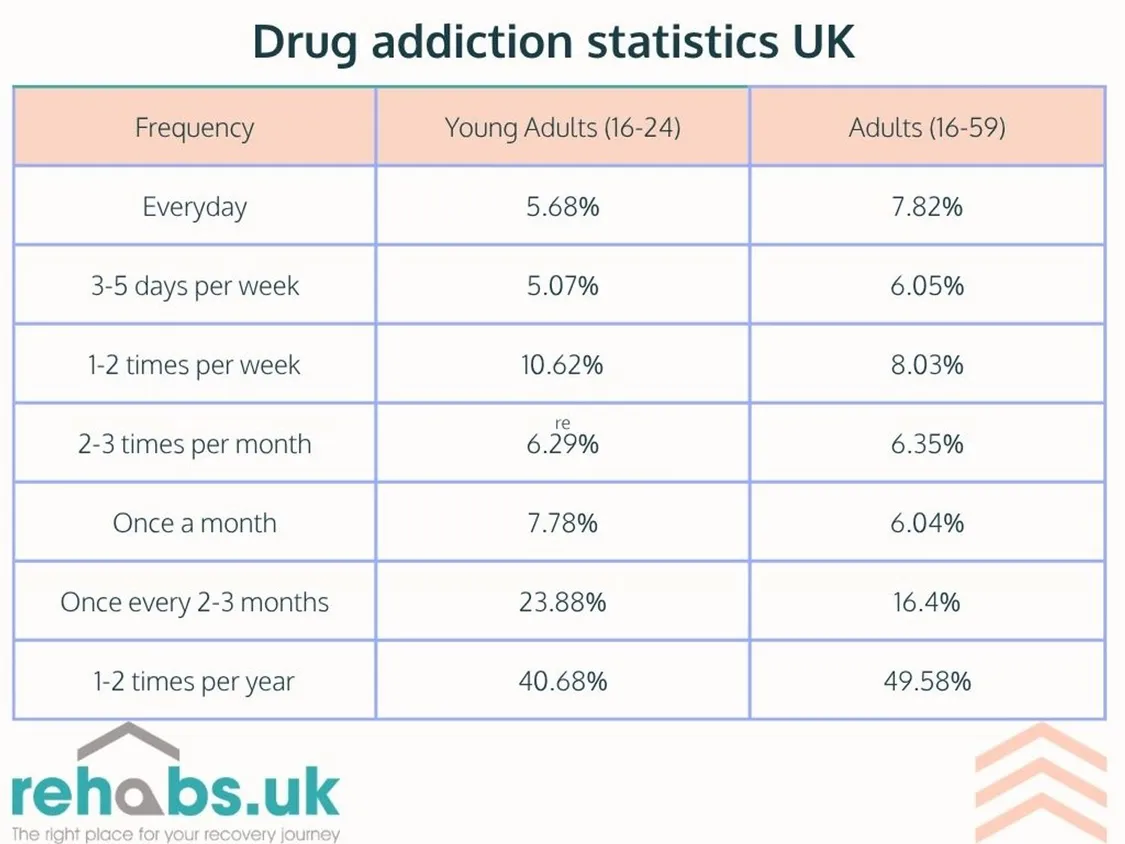
Source: Drug misuse in England and Wales: year ending March 2025 - Published December 2025
England
According to an ONS report covering 2024:
- The highest death rate from drug poisoning in 2024 was in the North East (167.6 deaths per million) - this region has had the highest rate for 12 years.
- The East of England had the lowest rate (66.3 deaths per million).
- London saw the highest increase, rising from 58.1 to 76.5 deaths per million. (+31.67%)
- The South West had the biggest decrease, dropping to 83 deaths per million from 95.7 YoY. (-13.2%)
Deaths related to drug poisoning in England and Wales, 2024
Note: The national average for England as a whole is 91.85 deaths per million people, which would place it between the East Midlands and West Midlands.
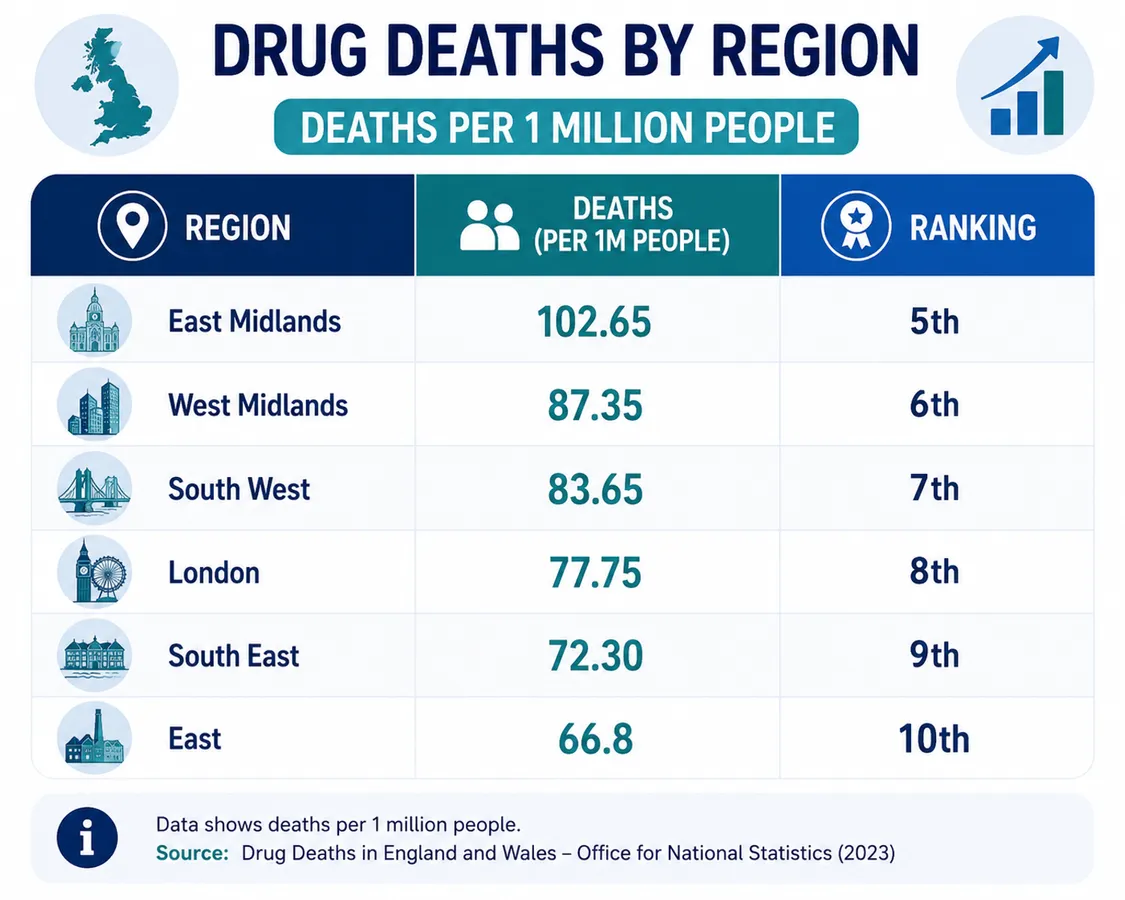
Table of drug deaths by region in the UK
- In 2024, the average combined mortality rate across the Northern regions (North East, North West, Yorkshire and the Humber) was 134.75 deaths per million. This is nearly twice the average rate of the Southern regions (London, South East, South West, East), which sat at 75.12 deaths per million.
- In 2024, the male mortality rate was at least double the female rate across almost all areas.
- In London, men (110 per million) are more than twice as likely to die from drug poisoning as women (45.5 per million).
- The North East, North West, Yorkshire and the Humber, West Midlands, South West, and the East of England all hit a peak in 2023, seeing figures ease in 2024.
Source: Deaths related to drug poisoning in England and Wales: 2024 registrations - Published October 2025
Scotland
- Despite a 13% fall in fatalities, official figures released in 2025 suggest there were 191 drug misuse deaths per million people in Scotland in 2024.
- This is the highest figure in Europe for the seventh consecutive year.
- 1,017 drug misuse deaths were registered in Scotland in 2024 - 13% fewer than 2023.
- This figure is the lowest since 2017.
- The average age of drug misuse deaths has increased from 32 to 45.
- In 2024, people in the most deprived areas of Scotland were 12 times more likely to have a drug misuse death.
The following table shows the council areas with the most and least drug misuse deaths between 2022 and 2024.
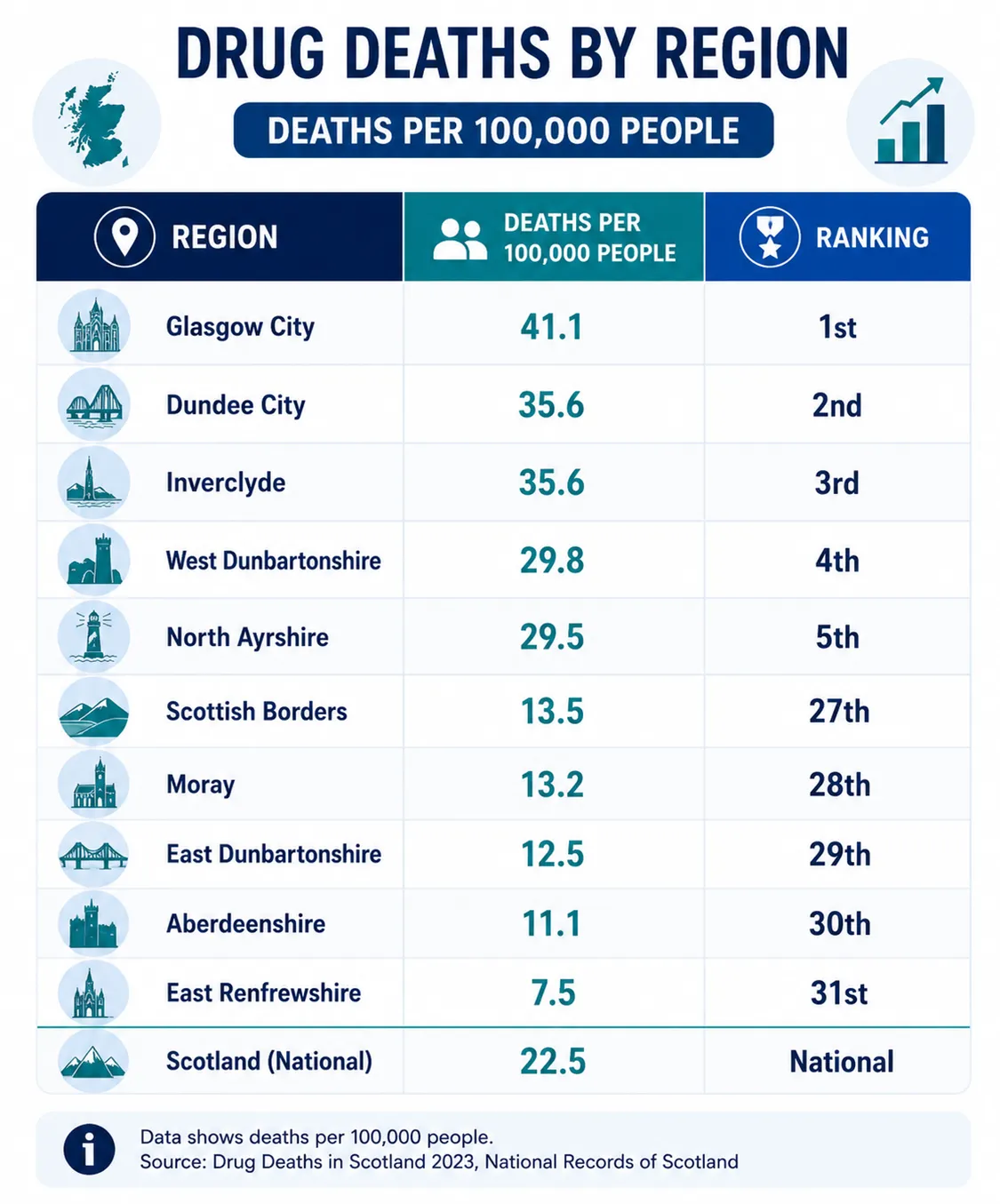
Table of drug deaths by region per 100,000 people in the UK
In the first 12 months since opening in Glasgow in January 2025, The Thistle, the UK's first safer drug consumption facility, has been accessed 11,348 times by 575 people.
Sources: Drug-related deaths in Scotland, 2024 - Published September 2025), Scottish drug deaths fall but remain worst in Europe. BBC News, Published September 2025, Glasgow's Safer Drug Consumption Facility Records More Than 11,000 Visits in First Year. Glasgow City Council - Published January 2025.
Wales
- Hospital admissions related to illicit drug use decreased by 10.6 per cent in 2024.
- Under 25s:
- The number of admissions in 2023-24 in this age group decreased by 8.6% compared to the previous year.
- Adults aged 25-49:
- Opioids account for 35.1% of admissions in this age group.
- Admissions for illicit drug poisonings decreased by 12.7%.
- Adults over 50:
- In 2023-24, adults over 50 accounted for 29.8 of illicit drug use admissions.
- Deaths from drug misuse registered in 2023 rose by 18.6% YoY - the highest on record.
- The most common drugs resulting in hospital admissions in 2023-24 were:
- Opioids (1,124 admissions - 19.2% YoY decrease)
- Cannabinoids (807 admissions - 12.4% YoY decrease)
- Cocaine (414 admissions)
- Benzodiazepines (313 admissions - 0 18.1% decrease
Sources: Annual profile for substance misuse 2023 to 2024, NHS Wales - Published March 2025.
Northern Ireland
According to the Northern Ireland Substance Misuse Database report, covering the year to March 2025, of the 3,889 clients that were recorded on the database:
- 33.4% presented for support with drug issues, 28.6% were suffering from both drug and alcohol misuse.
- 67.8% were male. 32.2% female.
- 45.3% of those seeking drug-only support were aged 26-39 years.
- 8.8% reported having injected at least once.
- 58% indicated daily drug use.
- The most common drugs being used were:
- Cannabis (49.4%)
- Cocaine 48.8%
- Pregabalin (13.5%)
- Benzodiazepines (11.7%)
Source: Statistics from the Northern Ireland substance misuse database 2024/25. Published December 2025
Health impact statistics
Drug-related deaths
- 5,565 deaths related to drug poisoning were registered in England and Wales in 2024 (93.9 deaths per million), increasing from 2023’s 5,448 deaths.
- Among men: 128.7 drug-poisoning deaths per million
- Among women: 60.6 drug-poisoning deaths per million
- Almost half of drug-poisoning deaths were confirmed to involve an opiate or opioid (47.1%)
- Nitazenes deaths were four times higher than in the previous year, increasing from 52 deaths to 195.
- Cocaine deaths rose for the 13th consecutive year, reaching 1,279 deaths (14.4% higher than 2023).
Source: Adult substance misuse treatment statistics 2024 to 2025: report - Published December 2025.
Homelessness
- Almost 1 in 10 people (9%) starting treatment in England believed they had a risk of homelessness in the next 8 weeks.
- For opiate users, this figure doubled to 18%.
- The highest figure (32%) was from users of psychoactive substances.
Source: Adult substance misuse treatment statistics 2024 to 2025: report - Published December 2025.
Treatment
- In England, 329,646 adults (aged 18+) were in contact with treatment services in the 12 months between April 2024 and March 2025.
- This was 6% more than the year before, and the highest on record.
- In 2024-25, 55% of people starting treatment in England self-referred or were referred by friends and family.
- 22% were referred by health and social care. Of this, 6% were GP referrals.
- 15% were referred from the criminal justice system
- 5% of referrals were from hospitals
- 4% were from social services.
- Over 99% of those in treatment during this period had some form of structured treatment. Of these:
- 99% were community-based
- 4% were in primary care
- 4% were inpatient
- 2% were residential
- During the 2024-25 period, 46% of those in England completed their treatment successfully. 37% dropped out.
- 49% of non-opiate treatment was successful
- 23% of opiate treatments were successful.
Source: Adult substance misuse treatment statistics 2024 to 2025: report - Published December 2025.
Treatment by substance
- Of the adults in treatment in England, 2024-25:
- 42% were there for support with opiates - the largest group, but 6% down on 2022.
- 19% were being treated for crack cocaine.
- 20% were being treated for powder cocaine.
- 22.2% of new entrants to treatment were for cannabis.
- 2.5% began treatment for benzodiazepine use.
- 3.2% started treatment for ketamine use - Ketamine use is now 12 times higher than it was ten years ago (2014-15), when just 426 people began treatment.
- People entering treatment for non-opiates increased by 20% in this period.
Sources: Adult substance misuse treatment statistics 2024 to 2025: report - Published December 2025.
Drug treatment by age
Based on 2024-25 data, the age of people seeking treatment in England is increasing, with 61% aged 40 or older, a 10% rise since 2017.
- People in drug treatment in England 2024-25 (by age group)
- 18-19 years old: 1.5%
- 20-24 years old: 4.9%
- 25-29 years old: 7.3%
- 30-34 years old: 11.1%
- 35-39 years old: 14.6%
- 40-44 years old: 16.6%
- 45-49 years old: 14.7%
- 50-54 years old: 12.4%
- 55-59 years old: 8.7%
- 60+ years old: 8.2%
- In the year ending March 2025:
- 3.3% of people aged 16 to 59 years had taken a Class A drug.
- 4.5% of people aged 16 to 24 years had taken a Class A drug.
Source: Adult substance misuse treatment statistics 2024 to 2025: report - Published December 2025, Drug misuse in England and Wales: year ending March 2025 - Published December 2025.
Substance misuse treatment in children
- Between 2024 and 2025, 16,212 children (aged 17 and under) were in alcohol and drug treatment in England.
- 13% more than the previous year.
- 34% lower than the peak (2008-2009).
- 86% came to treatment for cannabis use.
- Ketamine treatment problems among children are rising, reaching 9% of all cases - from 5% in 2021-22.
Source: Children's substance misuse treatment statistics 2024 to 2025 - Published December 2025
Drug treatment by gender
- Between April 2024 and March 2025, 72.6% of adults in contact with treatment services for opiates were men:
- Opiates: 100,418 (72.6%)
- Non-opiate only: 30,111 (68.9%)
- Non-opiate and alcohol: 34,066 (71.3%)
- Just under a third of people seeking treatment were women:
- Opiates: 37,837 (27.4%)
- Non-opiate only: 13,567 (31.1%)
- Non-opiate and alcohol: 13,692 (28.7%)
Sources: Adult substance misuse treatment statistics 2024 to 2025: report - Published December 2025.
Mental health and co-morbidity
- In 2024-2025, 74% of adults starting drug addiction treatment said they also had a mental health care need.
- The prevalence of co-occurring mental health needs spanned across all major substance categories:
- Non-opiate and alcohol group: 79% reported a mental health treatment need.
- Non-opiate only group: 73% reported a mental health treatment need.
- Alcohol only group: 73% reported a mental health treatment need.
- Opiate group: 71% reported a mental health treatment need.
Sources: Adult substance misuse treatment statistics 2024 to 2025: report - Published December 2025.
Find the right support for drug addiction
- If you or someone you know is struggling with addiction, there are effective and proven treatments available.
- Cognitive behavioural therapy
- 12-step programmes
- Residential Rehab
- Outpatient programmes and home detox
- Anti-craving medication for alcoholism
- Holistic non-12 step treatment
- Group therapy
- Counselling
Speaking to a medical professional or an addiction referral service like Rehabs UK is the first step towards recovery.
Whether it's detox, rehabilitation, or ongoing support, contact Rehabs UK to get the right advice and support for you.